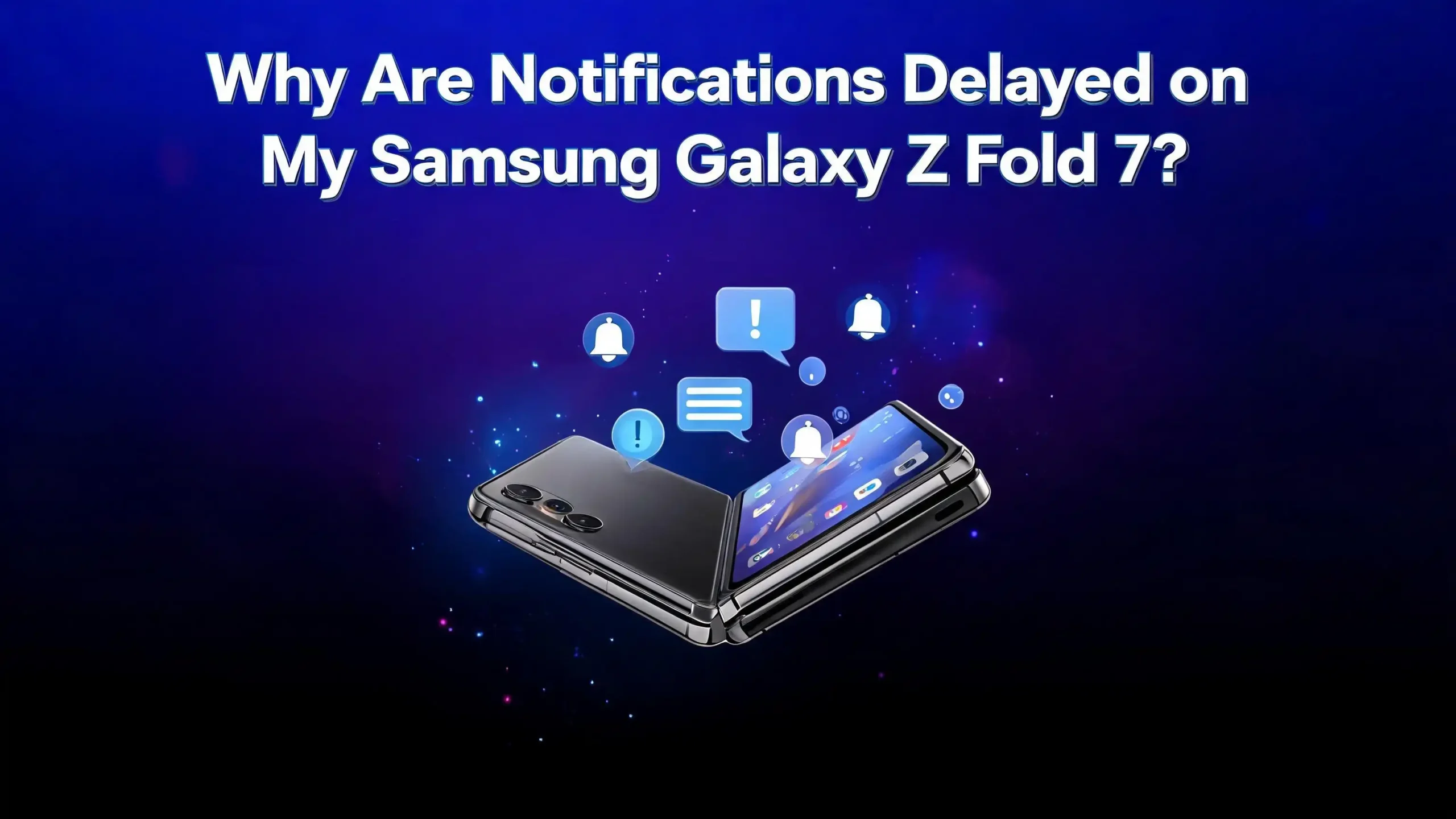
Why Are Notifications Delayed on My Samsung Galaxy Z Fold 7?
Are you picking up your Samsung Galaxy Z Fold 7 only to find a pile of notifications that should have arrived hours ago? You are not alone. Delayed notifications are one of the most common frustrations reported by Galaxy Z Fold 7 users, and the problem can hit at the worst possible times — missed messages, late alerts, and important emails that show up long after they were sent.
The Samsung Galaxy Z Fold 7, released on July 25, 2025, runs One UI 8 on top of Android 15 and packs a Qualcomm Snapdragon 8 Elite processor. It is a powerhouse device, but even powerful phones can have notification issues caused by software settings, battery management systems, or bugs in the operating system.
The good news is that most notification delay problems are fixable without visiting a service center. This guide walks you through every possible cause and every practical solution, step by step, so you can get your alerts back on time.
In a Nutshell
- Battery optimization is the number one culprit. Samsung’s One UI 8 aggressively manages battery by putting apps to sleep, which blocks background processes that deliver notifications.
- One UI 8 has a confirmed Do Not Disturb bug that resets exception settings and silently blocks notifications on the Galaxy Z Fold 7 and Z Flip 7, even when DND should allow certain alerts.
- Apps that are force-stopped or sleeping will not deliver notifications until you manually open them again, making it critical to check background usage limits.
- Wi-Fi Power Saving Mode and Data Saver reduce how often your phone connects to servers in the background, causing push notifications to arrive late.
- Clearing app cache and resetting app preferences can resolve hidden glitches that silently delay or block notification delivery.
- Keeping One UI updated is essential because Samsung actively patches notification bugs, and running an outdated version keeps known problems alive on your device.
Check If Do Not Disturb Is Accidentally On
The first thing to check before anything else is whether Do Not Disturb mode is active. This sounds obvious, but many users overlook this step because DND can be scheduled to turn on automatically without you noticing.
On the Galaxy Z Fold 7, swipe down twice from the top of your screen to open the full Quick Settings panel. Look for the Do Not Disturb tile. If it is highlighted or says “On,” tap it to turn it off immediately.
Beyond manually checking, go to Settings > Modes and Routines and review any scheduled routines that may be activating DND during work hours, sleep time, or at any other trigger point. Many users set up these routines during initial phone setup and forget they exist.
There is also a confirmed One UI 8 bug specifically affecting the Galaxy Z Fold 7 and Z Flip 7 that resets DND exception settings. If you set DND to allow calls or messages from specific contacts, the bug wipes those exception rules and blocks everything.
This bug was patched for Galaxy S25 series devices in a beta update, but the fix had not been rolled out to foldable devices at the time of reporting. Keep your phone updated through Settings > Software Update > Download and Install so you receive the patch as soon as Samsung releases it.
If DND keeps switching on by itself, go to Settings > Modes and Routines > Routines and delete or disable any routine that includes a “Turn on Do Not Disturb” action. This gives you full manual control until Samsung delivers a permanent fix.
Turn Off Battery Optimization for Important Apps
Samsung’s One UI 8 battery optimization system is smart, but it is too aggressive for apps that need real-time notifications. When Battery Optimization is active, the system limits how often background apps can communicate with the internet, which means push notifications get queued and delivered in batches instead of instantly.
Here is how to fix this for individual apps:
Go to Settings > Apps and search for the app giving you trouble, such as Gmail, WhatsApp, or Slack. Tap the app name, then tap Battery, and change the setting from Optimized to Unrestricted. The “Unrestricted” option tells One UI 8 to never limit that app’s background activity.
Alternatively, you can long-press the app icon on your home screen, tap the info icon (i), then go to Battery > Unrestricted.
Do this for every app whose notifications matter to you. Common candidates include messaging apps, email clients, calendar apps, and banking apps. Setting them all to Unrestricted ensures they can always run background processes to fetch and deliver alerts on time.
You should also visit Settings > Device Care > Battery > Background Usage Limits and make sure all critical apps appear under the “Never Auto-Sleeping Apps” list. Tap the + button and add any app you do not want the system to put to sleep automatically.
Disable Put Unused Apps to Sleep
One UI 8 includes a feature called “Put Unused Apps to Sleep” that automatically suspends apps you have not opened for a few days. When an app is asleep, it cannot receive or process background notifications. This is one of the most underdiagnosed causes of delayed notifications on Samsung Galaxy devices.
To turn this feature off, go to Settings > Battery > Background Usage Limits. You will see a toggle at the top labeled “Put unused apps to sleep.” Switch that toggle off completely.
Below the toggle, you will also see lists of apps currently categorized as sleeping or deep sleeping. Remove any important apps from these lists by tapping them and selecting “Remove.”
If you want a middle ground rather than disabling the feature entirely, you can leave it on but add your critical apps to the “Never Auto-Sleeping” list. This way, only apps you genuinely never use get suspended, while your important apps stay active in the background at all times.
Users on the Samsung Community forums report that disabling this single setting resolves notification delays for the majority of cases. It is one of the most effective fixes available for the Galaxy Z Fold 7 and is worth checking before trying more advanced solutions.
Turn Off Battery Saver and Data Saver
Both Battery Saver and Data Saver restrict background activity in ways that delay notifications. Battery Saver limits how often apps can check for new data, while Data Saver blocks background internet access entirely for apps that are not in use.
To turn off Battery Saver, swipe down to open Quick Settings and look for the Battery Saver tile. If it is on, tap it to disable it. You can also go to Settings > Battery > Power Saving Mode and toggle it off.
To turn off Data Saver, go to Settings > Connections > Data Usage > Data Saver and switch it off. If you want to keep Data Saver on to manage your data bill, you can add specific apps to the “Allowed to use data while Data Saver is on” list within the same menu. Adding your notification-critical apps here lets them fetch data in the background even when Data Saver is active for other apps.
It is also worth checking your mobile data settings per app. Go to Settings > Apps, tap the app in question, tap Mobile Data, and make sure “Allow background data usage” is enabled. Without this, apps cannot receive push notifications when you are on a mobile network and the screen is off.
Disable Wi-Fi Power Saving Mode
Wi-Fi Power Saving Mode is a hidden setting that many Galaxy Z Fold 7 users do not know exists. When this mode is active, the phone reduces the frequency at which it communicates with your Wi-Fi router while the screen is off. The result is that notifications from online services arrive late because the phone is not actively listening to the network.
To disable it, go to Settings > Connections > Wi-Fi. Tap the three-dot menu in the top right corner and select Intelligent Wi-Fi. Look for “Wi-Fi Power Saving Mode” and toggle it off.
This setting is separate from the general Battery Saver and is often left on by default. Turning it off alone has resolved notification delays for many users, especially those who primarily use Wi-Fi at home or at the office. The battery impact of disabling this setting is minimal in practice, making it a straightforward fix.
If you use your Galaxy Z Fold 7 on both Wi-Fi and mobile data, also consider checking Settings > Connections > Mobile Networks > Network Mode and making sure your phone is set to use the best available network automatically. A weak or unstable network connection directly contributes to delayed push notifications.
Fix Account Sync Settings
Email and calendar notifications depend on account sync. If your Google, Samsung, or other email accounts are not set to sync automatically, you will only receive new emails or calendar alerts when the phone manually syncs, which may happen infrequently.
To check and fix account sync settings, go to Settings > Accounts and Backup > Manage Accounts. Tap each account listed, then tap Sync Account. Make sure the toggle for “Auto Sync” is turned on and that all relevant sync categories (Mail, Calendar, Contacts, etc.) are enabled.
You can also pull down the Quick Settings panel, swipe to find the Sync tile, and make sure it is enabled. If Sync has been turned off, all background account refreshes stop, and you will miss real-time alerts from email services and apps that rely on account data.
For Google accounts specifically, go to Settings > Google > Account Services and make sure “Auto-Sync Data” is turned on at the top. Google apps like Gmail and Google Calendar depend entirely on this setting to push real-time notifications to your device.
Clear App Cache for Problematic Apps
A corrupted or overloaded app cache can cause all sorts of unexpected behavior, including delayed or missing notifications. Clearing the cache removes temporary files without deleting your app data, logins, or preferences, making it a safe first step when a specific app is not notifying you properly.
To clear the cache for an app, long-press the app icon on your home screen, tap the info icon (i), then go to Storage > Clear Cache. Tap it and confirm.
You can also navigate to Settings > Apps, tap the app name, go to Storage, and tap Clear Cache from there.
Do this for any app that has been consistently late with notifications. Common apps worth clearing include Samsung Messages, WhatsApp, Gmail, Outlook, Instagram, and any social media app. After clearing the cache, open the app once to reinitialize it, then lock your screen and wait to see if notifications start arriving on time.
If clearing the app cache does not help, consider taking the more thorough step of tapping Clear Data instead. Note that Clear Data removes all app data including login sessions, so you will need to sign back in. Use this only if clearing the cache did not work.
Reset App Preferences
If you have been adjusting app settings, clearing defaults, or changing permissions, you may have accidentally altered a setting that affects notification delivery. Resetting app preferences restores all default settings for every app on your phone without uninstalling any of them or deleting personal data.
To reset app preferences, go to Settings > Apps. Tap the three-dot menu in the top right corner and select Reset App Preferences. Confirm when prompted.
This action resets disabled apps, background data restrictions, permission restrictions, default app settings, and notification restrictions all at once. It is a powerful reset that often resolves notification issues caused by accidental configuration changes.
After resetting, go back through your notification preferences for each app and re-enable any custom preferences you want to keep. You may also want to revisit Settings > Apps > [App Name] > Notifications and ensure the specific notification categories you want are enabled, since a reset may restore some apps to their default “off” state for certain notification types.
Check Individual App Notification Settings
Sometimes the problem is not a system-wide issue at all. Each app has its own notification settings that control which types of alerts are sent, how they are displayed, and whether they make a sound or appear on the lock screen.
To check an app’s notification settings, go to Settings > Apps, tap the app, then tap Notifications. You will see a list of notification categories. Make sure the main toggle is on and that each category you care about is enabled.
You should also go to Settings > Notifications > App Notifications and scroll through the full app list. Look for any apps where notifications have been turned off. Tap each app and toggle on “Allow Notifications” to restore delivery.
Do not forget to check notification settings inside the apps themselves. Many apps like Gmail, WhatsApp, and Slack have separate internal notification settings that override system settings. Open the app, go to its settings, and verify that notifications are turned on and set to the correct alert level.
Also check Settings > Notifications > Lock Screen Notifications and make sure the option is set to “Show all notification content” so that alerts appear on your lock screen when the phone is idle.
Disable Force-Stopped State for Apps
When an app has been force-stopped, Android shuts down all its background services completely. A force-stopped app cannot receive any push notifications until you manually open it again. If you or a system process has force-stopped an app, that is exactly why its notifications are not coming through.
To check if an app has been force-stopped, go to Settings > Apps, find the app, and tap it. If the “Force Stop” button is greyed out, the app is running normally. If it is active, the app may have been stopped.
The fix is simple: open the app manually. Once you launch it, all background services restart, and notifications begin arriving again. Avoid force-stopping apps that you rely on for real-time notifications. Only use force-stop as a last resort for troubleshooting, not as a regular practice.
If you use a memory or RAM cleaner tool on your phone, be aware that these tools often force-stop apps as part of their cleanup process. Disable or avoid using RAM cleaner apps that automatically kill background services, since they directly interfere with notification delivery.
Update One UI and All Apps
Running an outdated version of One UI 8 is a common reason for persistent notification bugs on the Galaxy Z Fold 7. Samsung actively releases security and software patches that fix known bugs, including the confirmed DND exception bug that causes missed notifications on foldable devices.
To check for a One UI update, go to Settings > Software Update > Download and Install. If an update is available, download and install it, then restart your phone.
To update your apps, open the Google Play Store, tap your profile icon in the top right, and go to Manage Apps and Device. Tap “Update All” to install all pending app updates at once.
Outdated apps sometimes use older notification APIs that conflict with newer versions of One UI, causing delivery failures or delays. Keeping both the system software and your apps up to date is one of the best long-term maintenance habits you can build for reliable notification performance.
Restart Your Phone and Network Connections
A simple restart resolves a surprising number of notification issues. When your phone has been running for many days without a restart, background processes can accumulate errors, memory can become fragmented, and push notification connections to servers can drop silently.
Restart your Galaxy Z Fold 7 by pressing and holding the side button, then tapping Restart. Wait for the phone to fully boot before testing notifications.
You should also try toggling Airplane Mode on and off. Swipe down to the Quick Settings panel, tap the Airplane Mode tile to enable it, wait five seconds, then tap it again to disable it. This resets all network connections at once, including Wi-Fi, mobile data, and Bluetooth, often reconnecting your phone to notification servers with a fresh session.
If you are on Wi-Fi, go to Settings > Connections > Wi-Fi, long-press your network name, and tap Forget Network. Then reconnect by entering your password. This resets the Wi-Fi session and can fix notification delays caused by a stale or poor-quality wireless connection.
Check for Conflicting Third-Party Apps
Third-party battery saver apps, cleaner apps, and task killer apps are among the biggest hidden causes of notification delays on Samsung devices. These apps often run in the background and automatically kill or restrict other apps to free up memory and battery, directly interfering with notification services.
To identify if a third-party app is causing the issue, boot your Galaxy Z Fold 7 into Safe Mode. To do this, press and hold the side button, then long-press Power Off until you see the Safe Mode option. Tap it and confirm.
In Safe Mode, only pre-installed system apps run. If your notifications arrive on time in Safe Mode, a third-party app is definitely causing the problem. Boot back into normal mode and uninstall battery saver apps, RAM cleaners, or any app management tools you installed recently.
Common culprits include apps like DU Battery Saver, Clean Master, or any third-party app with keywords like “booster,” “cleaner,” or “optimizer” in the name. Samsung’s own Device Care built into One UI is sufficient for system optimization and does not cause the same aggressive interference.
Perform a Network Settings Reset
If none of the above steps have resolved the issue, resetting your network settings is the next logical move. A corrupted network configuration can prevent your phone from maintaining a stable connection to push notification servers, causing intermittent or severely delayed alerts.
To reset network settings, go to Settings > General Management > Reset > Reset Network Settings. Tap Reset Settings and confirm. Note that this will erase all saved Wi-Fi passwords, Bluetooth pairings, and VPN settings, so be prepared to reconnect to your networks afterward.
After the reset, reconnect to your Wi-Fi network and mobile data. Open a few apps and verify that notifications are now arriving in real time. This reset clears any misconfigured connection preferences that may have been silently disrupting background data delivery.
Some users also find success by going to Settings > Connections > Mobile Networks > Network Operators and selecting their carrier manually rather than relying on automatic selection. This forces a fresh connection to the carrier’s network, which can resolve push notification delivery issues tied to mobile data.
Factory Reset as a Last Resort
If you have tried every solution above and your notifications are still delayed, a factory reset is the most thorough fix available. A factory reset erases all data and returns the phone to its original software state, eliminating any deeply embedded software issues that individual settings changes cannot fix.
Before doing a factory reset, back up everything important. Go to Settings > Accounts and Backup > Back Up Data and create a full backup to Samsung Cloud or Google Drive. Save photos, contacts, app data, and any important files.
To perform a factory reset, go to Settings > General Management > Reset > Factory Data Reset. Tap Reset and confirm with your PIN. The phone will restart, wipe all data, and reboot as if brand new.
After the reset, set up your phone fresh without restoring from a backup first. Test notifications in this clean state. If notifications work perfectly, then the issue was caused by a corrupted app, setting, or data conflict from your previous setup. You can then restore your backup and reinstall apps selectively, checking after each installation to identify any that reintroduce the problem.
Frequently Asked Questions
Why do my Samsung Galaxy Z Fold 7 notifications only show when I unlock my phone?
This happens because the phone’s battery optimization system is queuing notifications while the screen is off and delivering them all at once when you unlock. The fix is to go to Settings > Battery > Background Usage Limits, turn off “Put Unused Apps to Sleep,” and set critical apps to Unrestricted battery usage.
Does One UI 8 have a known notification bug on the Galaxy Z Fold 7?
Yes. There is a confirmed bug in One UI 8 where Do Not Disturb exception settings get reset automatically, causing the phone to block notifications it should allow. Samsung patched this for Galaxy S25 devices first. Keep your phone updated via Settings > Software Update to receive the fix for foldable devices.
Will turning off battery optimization drain my battery faster?
Setting a few critical apps to Unrestricted battery usage has a minor impact on battery life. Most users report that the difference is negligible. You do not need to set every app to Unrestricted — only the apps you rely on for time-sensitive notifications like messaging and email.
Can Wi-Fi Power Saving Mode cause delayed notifications on the Z Fold 7?
Yes. Wi-Fi Power Saving Mode reduces how often your phone communicates with the router while idle, which delays push notifications delivered over Wi-Fi. Disabling it at Settings > Connections > Wi-Fi > Three-Dot Menu > Intelligent Wi-Fi resolves this in many cases.
How do I stop Samsung from putting apps to sleep automatically?
Go to Settings > Battery > Background Usage Limits and toggle off “Put Unused Apps to Sleep.” You can also add specific apps to the “Never Auto-Sleeping Apps” list if you want to keep the feature active for unused apps while protecting your important apps.
Why do I get notification delays only on mobile data but not on Wi-Fi?
This usually means Data Saver is active. Go to Settings > Connections > Data Usage > Data Saver and disable it, or add your critical apps to the allowed list. Also check that background data usage is enabled for each app under Settings > Apps > [App Name] > Mobile Data.
Should I use a third-party battery saver app on the Galaxy Z Fold 7?
No. Third-party battery saver and cleaner apps frequently kill background processes, which directly causes notification delays. Samsung’s built-in Device Care is more than sufficient for system maintenance and does not interfere with notification delivery the way third-party optimization apps do.
What is the fastest single fix to try first for notification delays on the Z Fold 7?
Go to Settings > Battery > Background Usage Limits and turn off “Put Unused Apps to Sleep.” Then set your most important apps to Unrestricted battery usage. This single change resolves the notification delay problem for the majority of Galaxy Z Fold 7 users.

Hi, I’m Lily — a tech enthusiast and the voice behind SmartResizerr.com. I love testing gadgets, breaking down specs into plain English, and helping everyday people find the right tech without the overwhelm.